
 English
 Arabic
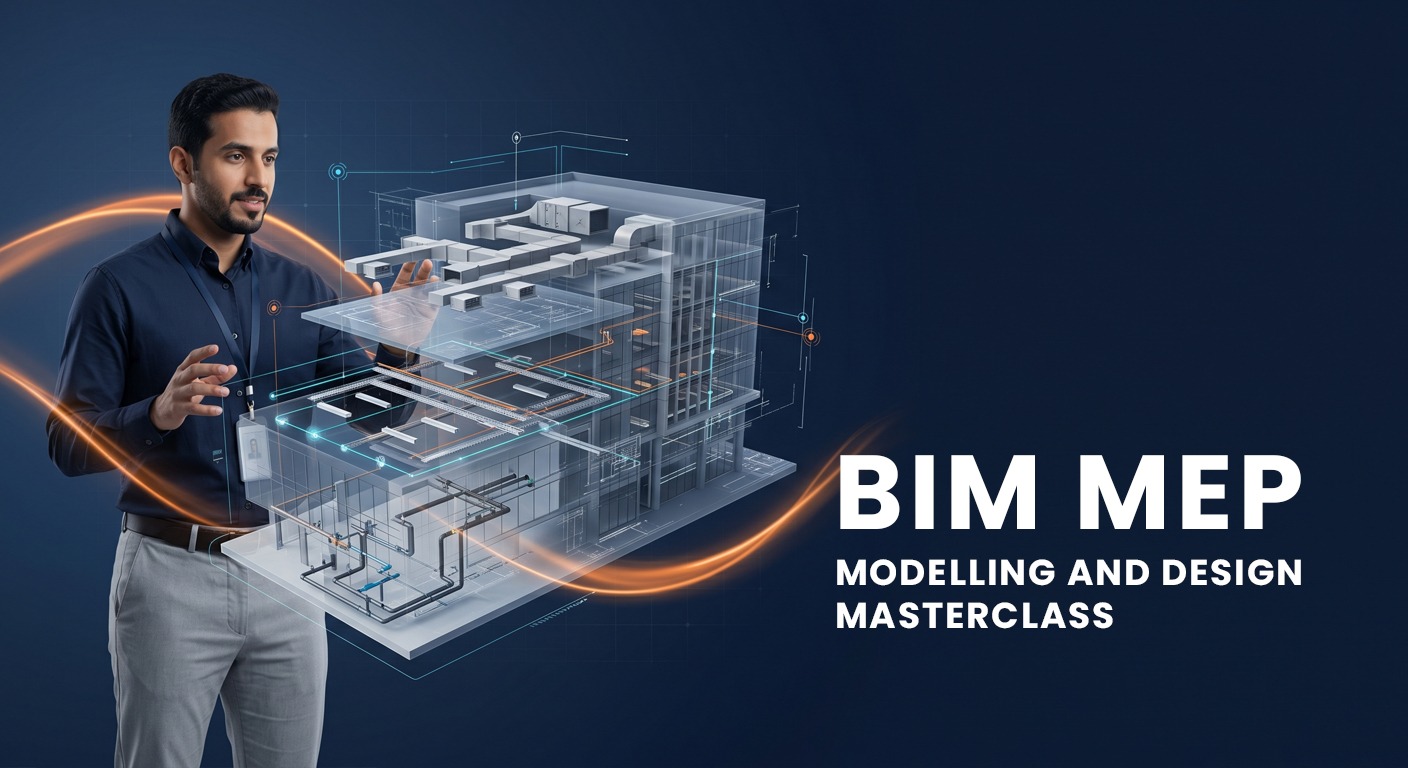
BIM MEP Modelling and Design Masterclass
A structured, professional-level live programme that gives MEP engineers, designers, and construction specialists a practical foundation in BIM for mechanical, electrical, and plumbing systems — covering fundamentals, Revit MEP tools, multi-discipline coordination, modelling techniques, and real GCC project applications, responding directly to the growing BIM deliverable requirements across UAE, Saudi Arabia, and Qatar.
Description
Programme Highlights
Built for the GCC BIM Mandate Reality
Project owners across UAE, Saudi Arabia, and Qatar now require full BIM deliverables for MEP systems as a condition of contract. This programme directly addresses the skills gap that creates: giving working MEP engineers the BIM workflow knowledge and Revit MEP exposure needed to meet those requirements on active projects.
MEP Coordination and Clash Detection in Context
Move beyond isolated modelling exercises into the multi-discipline coordination workflows that define professional MEP BIM practice — covering clash detection principles in Navisworks, BCF issue tracking, and the coordination meeting processes used to resolve structural-MEP spatial conflicts on GCC construction projects.
Practical Revit MEP Modelling Techniques
Develop working knowledge of the Revit MEP modelling approach for ducts, pipes, and conduits — covering families, system types, parameter management, and LOD-aligned modelling discipline that produces models meeting the deliverable standards required on GCC professional construction projects.
Middle East Case Studies and Career Pathways
Ground the learning in real construction programme contexts — examining how BIM MEP workflows operate on live projects across the GCC, understanding what employers and clients actually require from MEP BIM professionals, and mapping the career pathways available to engineers who build this capability.
Course Curriculum — 6 Modules
BIM Fundamentals for MEP
Establish the conceptual foundation that makes BIM MEP practice meaningful — moving beyond the common misconception that BIM is a software skill and establishing the correct understanding: BIM as an information management process that MEP engineers participate in as contributors, not simply as modellers. This module addresses what BIM means specifically in MEP engineering contexts: how mechanical, electrical, and plumbing systems are represented as data-rich objects rather than 2D line work, how LOD standards define what an MEP model element must contain at each project stage from schematic design through to construction and handover, and how BIM-driven MEP delivery differs from traditional 2D CAD documentation in terms of accuracy, coordination capability, and downstream usability for commissioning and facilities management. The GCC industry context is addressed directly: the government and client BIM mandates now in force across UAE, Saudi Arabia, and Qatar — including DEWA, Kahramaa, and Saudi Aramco engineering standards that require BIM deliverables from MEP contractors and subcontractors — and the skills gap this creates for engineers trained in 2D CAD environments who now need to operate in BIM project delivery programmes.
MEP Systems and BIM Scope
Develop a comprehensive understanding of how each MEP discipline is scoped, modelled, and coordinated within a BIM project environment — the discipline-level knowledge that allows MEP engineers to work effectively within a multi-consultant BIM delivery programme. This module maps the BIM scope for mechanical systems: HVAC supply and return air networks, chiller plants, AHUs, FCUs, and the LOD progression from schematic routing at LOD 200 through coordinated installation geometry at LOD 350. Electrical BIM scope covers LV distribution, lighting layouts, cable tray routing, and the data requirements that connect Revit electrical models to load calculations and panel schedules. Plumbing BIM scope addresses cold and hot water supply, drainage, and the slope and penetration coordination challenges that make plumbing one of the highest-conflict MEP disciplines in GCC residential tower and commercial building coordination programmes. The module defines MEP BIM deliverables on construction projects — coordinated models, clash-resolved federated files, construction drawing packages, and equipment and material schedules — and maps the team roles: MEP BIM Manager, MEP BIM Coordinator, discipline BIM modeller, and the coordination interface with structural and architectural BIM leads.
BIM Software Tools for MEP
Develop practical familiarity with the software environment that MEP BIM work is executed in — moving from conceptual understanding to direct engagement with the tools used on professional MEP BIM projects across the GCC. This module introduces the Autodesk Revit MEP interface: the discipline-specific workspace, system browser, project settings for duct, pipe, and electrical system families, and the model organisation structure that separates mechanical, electrical, and plumbing work within the same project file. Key MEP modelling tools are introduced: duct and pipe layout commands, air terminal and diffuser placement, electrical circuit creation, conduit and cable tray routing, and the system connection logic that makes Revit MEP models analytically capable rather than just geometrically representative. The module covers the software workflow for collaborative MEP project environments: how MEP models are linked to architectural and structural host files, file naming and workset configuration for multi-discipline environments, NWC export settings for Navisworks coordination, and the Autodesk BIM 360 and ACC cloud collaboration environment used on major GCC construction contracts. File format interoperability is addressed — IFC export from Revit, DWG and PDF documentation output, and the data exchange workflows that connect Revit MEP models to Navisworks, facility management platforms, and client-facing BIM deliverable packages.
MEP Coordination Workflows
Understand the multi-discipline coordination process that is the operational core of MEP BIM practice on GCC construction projects — the workflow that prevents the spatial conflicts between MEP services, structural elements, and architectural components from becoming site-level cost and programme impacts. This module covers the complete coordination sequence: how MEP models are federated with structural and architectural models in Navisworks Manage, how clash tests are configured between MEP discipline pairs and between MEP and structural systems, how clash results are categorised by severity and system type, and how coordination comments and resolution responsibilities are assigned using BCF workflows that connect Navisworks outputs to coordination issue registers and project management platforms. Participants understand the coordination meeting process used on GCC projects: agenda structure, clash prioritisation, resolution timeline management, and the escalation protocols that handle coordination conflicts between the MEP subcontractor, main contractor, structural engineer, and architectural consultant. The module addresses the specific MEP coordination challenges most frequently encountered on GCC commercial and residential projects: HVAC ductwork versus structural transfer beams in podium levels, electrical cable tray routing in congested false ceiling zones, and drainage slope management through slab penetration coordination — the recurring conflict types that drive the greatest coordination workload on large-scale building projects in the region.
BIM Modelling Techniques
Develop the practical modelling knowledge that enables MEP engineers to contribute directly to BIM project environments — covering the Revit MEP modelling approaches for duct, pipe, and conduit systems that produce models meeting professional deliverable standards on GCC construction projects. This module addresses duct modelling techniques: rectangular and circular duct routing, duct sizing and velocity calculations, fitting and transition management, and the duct system type configuration that connects modelled elements to Revit's analytical HVAC calculation engine. Pipe modelling covers slope management and gravity drainage routing, pipe sizing, valve and fitting placement, and the system type assignments that categorise pipe elements by fluid, temperature, and pressure. Conduit and cable tray modelling covers routing strategies for congested false ceiling environments, bend and offset management, and the parameter configuration that makes electrical models compliant with LOD 300 and LOD 350 delivery requirements. The module directly addresses the common modelling errors encountered in MEP BIM practice — disconnected system segments, incorrect fitting assignments, missing slope definitions, and parameter data gaps — and develops the quality checking habits that prevent these errors from propagating through to coordination and documentation output stages on live GCC project delivery programmes.
Real Project Applications
Ground the programme's conceptual and technical learning in the real construction project environments where BIM MEP is practised — examining how the workflows, tools, and standards covered across the previous five modules operate on live programmes in the GCC construction market. This module uses case studies from MEP BIM delivery on commercial, residential, healthcare, and infrastructure projects across UAE, Saudi Arabia, and Qatar to examine how MEP BIM coordination reduces RFIs and change orders, how LOD-compliant MEP models connect to procurement and commissioning workflows, and how BIM MEP deliverables are structured for government authority and project owner acceptance. Workflow optimisation is addressed: the process improvements that reduce modelling cycle times, the clash detection frequency and discipline that prevent late-stage coordination failures, and the documentation production workflows that connect coordinated MEP models to the construction drawing packages and equipment schedules required by main contractors and specialist MEP subcontractors. The module concludes with a structured examination of the BIM MEP career landscape in the GCC: the roles available — MEP BIM Modeller, MEP BIM Coordinator, BIM Manager, and VDC Engineer — the competency profiles employers require, the certification pathways available through Autodesk and international BIM professional bodies, and the salary and career progression data that reflects the market value of MEP BIM skills in the UAE, Saudi, and Qatar construction markets.
Software, Standards & Platforms
Course Outcome
On completing this course, you will be equipped to contribute to BIM-enabled MEP projects with confidence — understanding industry-standard workflows, coordination processes, and modelling techniques, and ready to apply them in real construction environments across the Middle East and beyond. You will be positioned for roles in MEP BIM modelling, coordination, and project delivery, with the foundational competency to pursue advanced Revit MEP, Navisworks, and BIM management specialisations.
