
 English
 Arabic
PMP®8 Ed -PMP Exam Prep with AI& Primavera P6
A complete 35-hour self-paced video pathway to PMP® certification, aligned to the PMBOK® Guide, 8th Edition and the 2026 Examination Content Outline. Candidates gain hands-on practice in AI-powered pr...
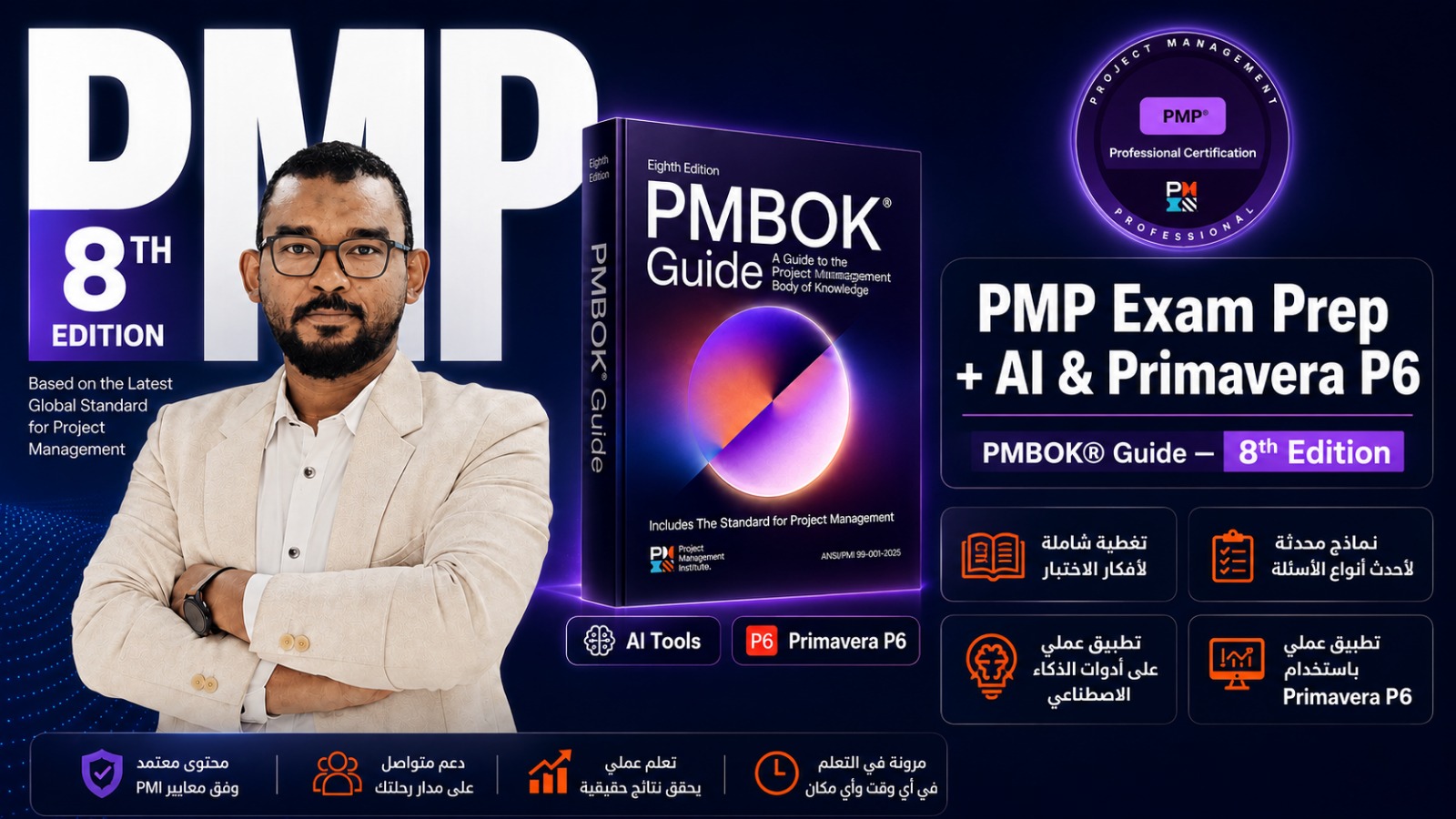
PMP®8 Ed -PMP Exam Prep with AI& Primavera P6
This course includes:
- 19h 03m 24s
- 75 Lectures
- 10 Downloadable resources
- Certificate of completion
Instructor
Eng. Abdalla Yousif
Overview
A complete 35-hour self-paced video pathway to PMP® certification, aligned to the PMBOK® Guide, 8th Edition and the 2026 Examination Content Outline. Candidates gain hands-on practice in AI-powered project tools and Primavera P6, with up to one year of access and continuous instructor support.
Description
Programme Highlights
AI-Powered PM Tools in Practice
Apply AI tools to real scheduling, risk forecasting, and reporting workflows — not just theory — building the practical fluency GCC project teams increasingly expect.
Hands-On Primavera P6 Scheduling
Build, baseline, and progress a live project schedule in Primavera P6 — the platform mandated on major Saudi Aramco, ADNOC, NEOM, and Ashghal contracts.
2026 ECO-Aligned Scenario Practice
Practice situational-judgment and multi-answer question formats matched to the July 2026 Examination Content Outline weighting across all three PMI® domains.
35 Hours, Self-Paced, Up to 1 Year Access
Learn on your own schedule with continuous instructor support throughout — structured for working professionals balancing certification with full-time roles.
Course Curriculum — 10 Modules
PMP® Certification Pathway & the 2026 Examination Content Outline
This opening module orients candidates to the complete 35-hour certification pathway — how the self-paced video curriculum is structured, how the three PMI® domains (People, Process, and Business Environment) map to exam weighting under the July 2026 Examination Content Outline, and how continuous instructor support operates throughout the programme. Candidates review the PMP® eligibility and application process, the structure of the PMBOK® Guide, 8th Edition as a principles-based framework rather than a rigid process checklist, and the situational-judgment question format that defines the current exam. The module also introduces how AI-powered project tools and Primavera P6 are woven through later modules as applied practice rather than standalone add-ons — preparing candidates targeting PMO, project controls, and senior delivery roles across Vision 2030 programmes, NEOM, Saudi Aramco, ADNOC, and Ashghal contracts to leave with both the credential and working tool proficiency.
Foundations of Project Management Across Predictive, Agile & Hybrid Environments
This module builds the delivery-approach foundation that runs through every subsequent domain. Candidates work through the twelve PMBOK® principles and the performance domains that replaced the older process-group structure, then apply a structured method for selecting between predictive, agile, and hybrid delivery based on project characteristics — requirements stability, stakeholder availability, regulatory constraints, and organizational maturity. Tailoring is treated as a core exam competency rather than an afterthought: candidates practice scenario questions where the correct answer depends on recognizing which approach — or blend of approaches — fits a given GCC megaproject context, from fixed-scope infrastructure contracts under FIDIC conditions to digital delivery workstreams run in parallel using agile sprints on the same programme.
People Domain I: Team Leadership, Conflict & Stakeholder Engagement
The People domain carries the largest single weighting on the 2026 ECO, and this module addresses its core competencies directly: leadership styles and when to apply each, the stages of team formation and development, structured conflict resolution frameworks, and stakeholder identification, analysis, and engagement planning. Candidates practice the situational-judgment format extensively here — questions that present a team or stakeholder conflict and ask for the best next action among several plausible options, reflecting the multicultural, multi-nationality project teams typical of GCC construction, energy, and infrastructure programmes where language, hierarchy expectations, and communication norms vary significantly across the workforce.
People Domain II: Servant Leadership, Virtual Teams & Emotional Intelligence
This module completes the People domain with the coaching-oriented competencies PMI® expects of a certified professional: servant leadership philosophy and its application in matrixed and functional organizations, structured coaching and mentoring techniques, and emotional intelligence frameworks for reading and responding to team dynamics under pressure. Virtual and distributed team management receives dedicated attention — a practical necessity for project managers coordinating design teams in one country, procurement in another, and site execution in a third, a common structure across regional infrastructure programmes. Scenario practice throughout this module mirrors the exam's emphasis on empowering rather than directing teams wherever the situation allows it.
Process Domain I: Scope, Schedule & Cost Management
This module covers the planning and control competencies at the core of the Process domain: scope definition and work breakdown structure development, schedule development techniques including critical path and critical chain methods, and cost estimating, budgeting, and earned value management. Candidates work through baseline management — establishing scope, schedule, and cost baselines and applying integrated change control when variance occurs — with scenario questions calibrated to predictive, agile, and hybrid contexts alike, since the exam increasingly tests whether candidates can apply the same underlying principle across different delivery approaches rather than a single fixed methodology.
Process Domain II: Risk, Quality & Procurement Management
This module addresses the remaining Process domain competencies that examiners weight heavily in 2026 scenario questions: risk identification, qualitative and quantitative risk analysis, and response strategy selection across threats and opportunities alike; quality management distinguishing quality assurance from quality control; and procurement management covering contract types, source selection, and vendor performance management. Regional contract context is built in throughout — FIDIC-based conditions common on GCC infrastructure and construction contracts, and the procurement governance expectations of major regional project owners including Saudi Aramco, ADNOC, and Ashghal — so candidates connect PMI® theory to the contractual environment they operate in.
Business Environment Domain: Governance, Compliance & Organizational Change
The smallest but most strategically weighted domain on the exam, Business Environment, is covered here in full: organizational governance frameworks and how projects are authorized and overseen within them, compliance and regulatory considerations that shape project constraints, benefits realization and business value measurement beyond project closure, and organizational change management models for embedding project outcomes into operations. Candidates examine how national transformation agendas — Saudi Arabia's Vision 2030, UAE federal and emirate-level infrastructure strategies, and Qatar's national development framework — translate into project-level governance and compliance requirements that PMI® expects certified professionals to navigate.
Applying AI-Powered Tools to Project Planning & Decision-Making
This module moves from certification theory into applied tool proficiency, addressing the AI-powered workflows candidates will actually use on the job. Coverage includes AI-assisted schedule risk forecasting and what-if analysis, natural-language project data queries that replace manual report building, automated status summary generation from raw project data, and AI-supported decision support for prioritization and resource allocation calls. The module distinguishes genuine productivity gains from AI hype — showing where AI tools reliably save a project manager time on GCC megaprogrammes with hundreds of live activities, and where human judgment, PMI® ethical standards, and contractual accountability must still govern the final decision.
Hands-On Schedule Development & Management in Primavera P6
Primavera P6 is the scheduling platform mandated on the majority of major GCC infrastructure and energy contracts, and this module builds direct working proficiency in it. Candidates practice creating a project WBS and activity list, defining logical relationships and constraints, resource and role loading, and setting and maintaining a schedule baseline. The module continues into progress updates and status data entry, critical path and float analysis, and generating the schedule reports — layouts, curves, and look-ahead views — that project controls teams submit to owners like Saudi Aramco, ADNOC, NEOM developers, and Ashghal on a routine reporting cycle.
Exam Readiness: Situational Judgment, Scenario Practice & Final Review
The closing module consolidates certification readiness through full-length, exam-representative practice matched to the 2026 ECO domain weighting across People, Process, and Business Environment. Every practice question includes a complete rationale — why the correct answer is right, why each distractor falls short, and the underlying PMBOK® principle or ECO task it maps to — reinforcing the reasoning the exam actually tests rather than isolated recall. Candidates finish with a structured final review checklist, guidance on exam-day pacing and question-triage strategy, and a clear view of any domain areas that warrant additional review before scheduling the PMI® exam.
Software, Standards & Platforms
Course Outcome
On completing this course, you will be equipped to sit the PMP® exam with confidence across the People, Process, and Business Environment domains, and to apply AI-powered planning tools and Primavera P6 scheduling in live project environments. These combined competencies map directly to PMO analyst, project controls specialist, and senior project management roles across Vision 2030 programmes, NEOM, Saudi Aramco, ADNOC, and Ashghal contracts throughout the GCC.
No Modules Available
Modules will be added soon
Curriculum
10 Section - 75 Lecture - 19h 03m 24sRequirement
Who this Course is for:
lang.no-target-audience-specified
