
 English
 Arabic
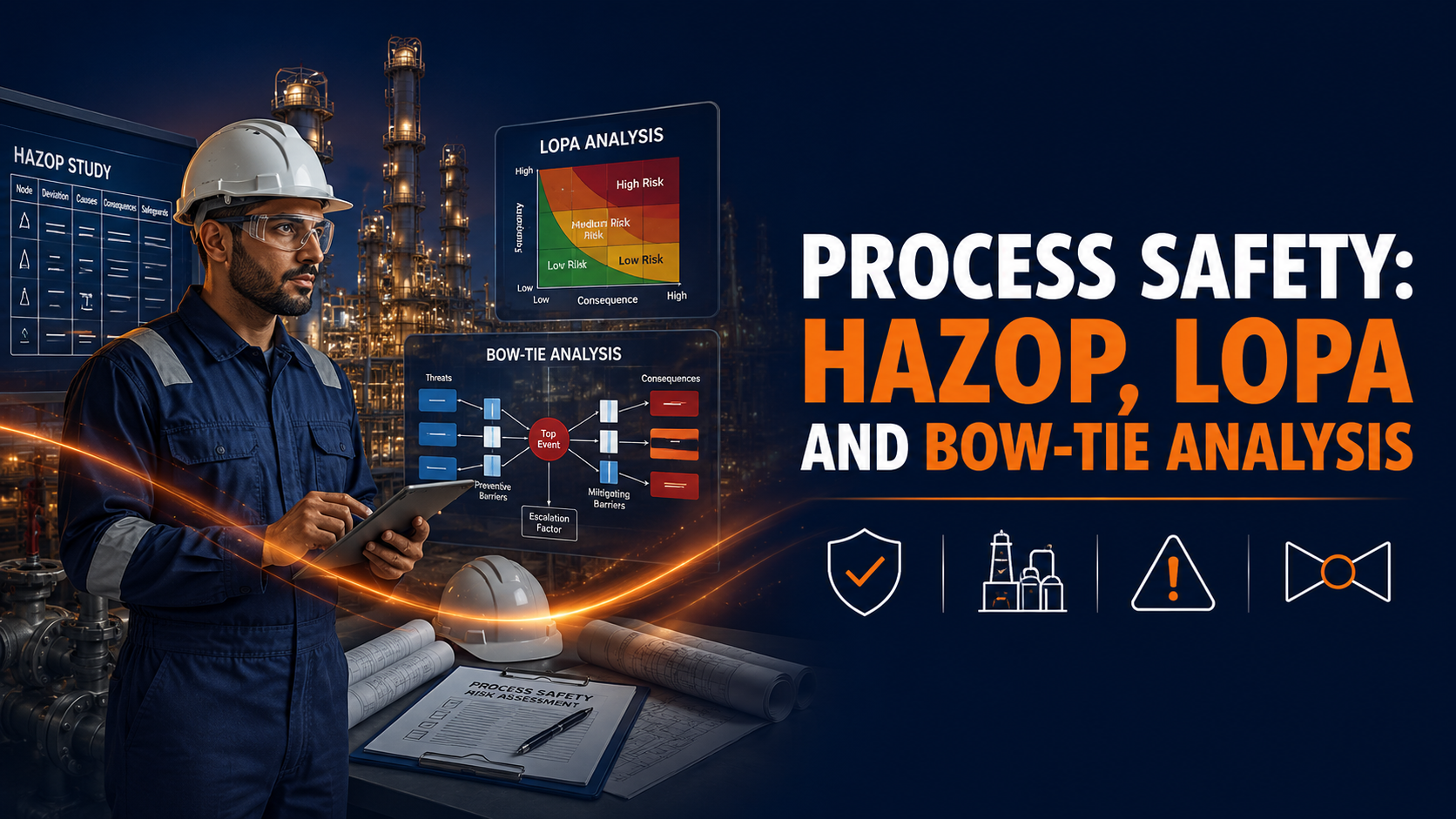
Process Safety: HAZOP, LOPA and Bow-Tie Analysis
A practical process safety risk-analysis programme for HSE professionals, process engineers, operations managers, and oil and gas engineers — covering HAZOP, LOPA, and bow-tie methodologies, safety-critical controls, and incident learning, built for the high-hazard industries and energy projects operated across Saudi Arabia, the UAE, Qatar, Kuwait, and Egypt.
Course starts in
Description
Programme Highlights
Three Core Risk-Analysis Methodologies
Build proficiency in HAZOP, LOPA, and bow-tie analysis within a single integrated programme — the three methodologies used across GCC high-hazard process industries.
From Qualitative to Semi-Quantitative Analysis
Progress from qualitative HAZOP deviation analysis to semi-quantitative LOPA risk tolerance decisions and visual bow-tie barrier mapping.
Facilitation & Workshop Practice
Develop the team roles, recording quality, and action tracking skills that determine whether a PHA workshop actually produces a usable risk register.
Capstone Risk Study
Perform a HAZOP/LOPA/bow-tie mini-study for a representative process scenario, assessed against professional deliverable standards.
Course Curriculum — 8 Modules
Process Safety Foundations — Major Accident Hazards, Barriers & ALARP
This module establishes the conceptual foundation that distinguishes process safety from occupational safety — a distinction that determines how risk is assessed, prioritised, and managed across every subsequent module. Major accident hazard concepts are introduced first: loss of containment, fire, explosion, and toxic release as the hazard categories that can affect multiple people, assets, and the environment simultaneously, in contrast to the personal-injury hazards addressed by occupational safety management. Barrier thinking is developed as the organising mental model for the entire programme: hazards are controlled by layers of independent barriers, no single barrier is assumed perfect, and major accidents typically occur when multiple barriers fail or degrade in combination rather than through a single point of failure. The ALARP (As Low As Reasonably Practicable) principle is covered in depth: the tolerability of risk framework that underlies risk-based decision-making across the process industries, the cost-benefit reasoning that determines when further risk reduction is reasonably practicable, and how ALARP demonstration connects to the documentation produced by the HAZOP, LOPA, and bow-tie methodologies covered later in the programme. The module closes by contrasting process safety and occupational safety performance indicators — recognising that strong occupational safety statistics do not guarantee process safety performance — and grounds this distinction in the major accident hazard facility regimes and safety case practices applied across Saudi Aramco, ADNOC, and SABIC operating assets.
PHA and HAZOP Methodology — Nodes, Guidewords & Deviation Analysis
This module builds the core HAZOP methodology skill that anchors the process hazard analysis (PHA) family of techniques covered across the programme. HAZOP is introduced per the IEC 61882 framework as a structured, systematic examination of a process design intended to identify potential hazards and operability problems — distinguished from other PHA techniques such as What-If analysis and checklist review by its rigorous, guideword-driven structure. Node selection is covered as the first practical skill: dividing a process flow diagram or P&ID into study nodes with clear design intent, and the judgement involved in selecting node boundaries that are neither too broad to analyse meaningfully nor so narrow that the study becomes unmanageable. Guideword application is developed systematically: the standard guideword set (No, More, Less, As Well As, Part Of, Reverse, Other Than) combined with process parameters (flow, pressure, temperature, level, composition) to generate deviations in a structured, repeatable way. The cause-consequence-safeguard structure is treated as the analytical core of each deviation: identifying credible causes, working through consequences with and without existing safeguards, and evaluating whether existing safeguards are adequate. The module closes with recommendation development: writing recommendations that are specific, actionable, and appropriately assigned, and the quality standard that distinguishes a HAZOP recommendation a project team can actually close out from a vague statement of concern — the facilitation skill this module sets up for deeper treatment in the workshop facilitation module.
LOPA Fundamentals — Initiating Events, Independent Protection Layers & Risk Tolerance
With HAZOP methodology established, this module introduces Layer of Protection Analysis (LOPA) as the semi-quantitative technique used to evaluate and prioritise the higher-consequence scenarios that HAZOP identifies but does not itself quantify. Initiating events are covered as the starting point of every LOPA scenario: identifying the specific cause that initiates a hazardous event sequence, and the frequency estimation practices — generic frequency data, plant-specific history, and industry reference sources such as CCPS data — used to assign a credible initiating event frequency. Independent protection layers (IPLs) receive the module's core technical depth: the strict independence, effectiveness, and auditability criteria a safeguard must meet to be credited as an IPL, common IPL examples such as basic process control system response, relief devices, and safety instrumented functions, and the discipline required to avoid crediting safeguards that do not genuinely meet IPL criteria. Consequence severity categorisation is addressed as the second input to the LOPA calculation, using company-specific severity matrices that rank outcomes by safety, environmental, and business impact. The module closes by bringing initiating event frequency, IPL credit, and consequence severity together into the LOPA calculation itself: comparing calculated mitigated event frequency against company risk tolerance criteria, and the resulting determination of whether additional risk reduction — potentially including a safety instrumented function with a defined Safety Integrity Level (SIL) — is required.
Bow-Tie Analysis — Threats, Top Events, Barriers & Degradation Factors
Bow-tie analysis is introduced in this module as the visual barrier-mapping technique that synthesises HAZOP causes and LOPA independent protection layers into a single diagram accessible to both technical specialists and non-technical stakeholders. Bow-tie structure is covered from the top event outward: the top event as the point of loss of control at the centre of the diagram, threats arrayed on the left as the causes that can lead to the top event, and consequences arrayed on the right as the outcomes that can follow it — a structure participants will recognise directly maps to the cause-consequence logic developed in the HAZOP module. Preventive barriers are covered as the controls positioned between threats and the top event, intended to stop a threat from developing into loss of control, while mitigative barriers are covered as the controls positioned between the top event and consequences, intended to reduce the severity of outcomes once loss of control has occurred — the same barriers, in many cases, that were credited as IPLs in the LOPA module, now represented visually. Degradation factors receive dedicated treatment as the module's distinguishing contribution: the conditions and failure modes that can weaken or defeat a barrier's intended function, and the escalation factor controls that protect barrier integrity. The module closes by positioning bow-tie diagrams as a communication and barrier-management tool: how bow-ties are used in management review, incident investigation framing, and safety-critical control assurance programmes across major hazard facilities in Saudi Arabia, the UAE, and Qatar.
Safety-Critical Controls — Barrier Performance Standards, Verification & Management of Change
With three risk-analysis methodologies established, this module addresses how the barriers identified through HAZOP, LOPA, and bow-tie analysis are actually kept effective throughout the operating life of a facility — the safety-critical controls discipline that closes the gap between analysis and sustained real-world performance. Performance standards are introduced as the foundational deliverable: defining the functionality, availability, reliability, and survivability requirements a safety-critical element must meet, and how performance standards translate the barrier credit taken in a LOPA study into a specific, verifiable engineering requirement. Verification and assurance activities are covered in depth: proof testing and functional testing regimes for safety instrumented functions, inspection and maintenance verification for mechanical barriers, and the assurance reporting that demonstrates a barrier remains fit for purpose over time rather than only at the point of design. Management of change (MOC) is treated as the discipline that protects barrier integrity against unintentional erosion: the MOC process for evaluating proposed technical, procedural, and organisational changes, the risk assessment triggers that determine when a change requires formal review, and the temporary change and time-limited risk acceptance practices that govern short-term deviations. The module closes by connecting safety-critical control management to the IEC 61511 safety instrumented system lifecycle conceptually, and to the barrier assurance programmes operated across major hazard facilities in the GCC, where safety-critical element registers and performance standard verification form a core part of asset integrity management.
Incident Learning — Root-Cause Patterns, Human Factors & Organisational Learning
This module treats incident learning as a structured professional discipline — the mechanism through which process safety events are converted into design, procedural, and cultural improvements rather than remaining isolated occurrences. Process safety event classification is introduced first, using tiered severity classification concepts consistent with industry reporting frameworks such as API RP 754: distinguishing loss-of-containment events by severity and consequence, and understanding why leading and lagging indicators together give a more complete process safety performance picture than lagging indicators alone. Root cause analysis techniques are covered comparatively: the systematic investigation methods used to move beyond immediate causes to the underlying management system and organisational factors that allowed an event to occur, and the discipline required to avoid stopping investigation at operator error when systemic factors are present. Common root-cause patterns are examined across the industry's collective experience: barrier degradation over time, inadequate management of change, and normalisation of deviance as recurring themes that appear across many different process safety events, without requiring dramatization of specific historical incidents. Human factors are addressed as a distinct discipline: how workload, procedure design, competence, and organisational pressure influence human performance and contribute to incident causation, moving beyond a purely technical view of process safety. The module closes with organisational learning practice: how findings are shared across a facility and a company, the discipline required to prevent recurrence at other similar assets, and the learning culture that GCC major hazard operators such as Saudi Aramco and ADNOC embed within their process safety management systems.
Workshop Facilitation — Team Roles, Recording Quality & Action Tracking
A technically sound HAZOP, LOPA, or bow-tie methodology delivers limited value if the workshop that applies it is poorly run — this module addresses the facilitation discipline that determines whether a PHA study actually produces a usable, defensible risk register. Team roles are covered first: the facilitator's responsibility for methodology discipline and pace, the scribe's responsibility for accurate real-time recording, and the technical team composition — process, operations, and maintenance representation — required for a credible study. Workshop preparation is treated as a determinant of study quality rather than an administrative formality: P&ID and design information readiness, node list preparation, and the pre-work that prevents a workshop from stalling on missing information. Recording quality receives dedicated attention: capturing sufficient technical detail to support later verification and audit without slowing workshop pace to the point of participant disengagement, and the balance experienced facilitators strike between thoroughness and momentum. Action tracking is covered as the discipline that connects a workshop to real risk reduction: assigning clear ownership and realistic timelines, tracking actions through to verified closure rather than administrative closure, and the governance that prevents open actions from being quietly abandoned. The module closes with report structure: the standard sections expected in a HAZOP, LOPA, or bow-tie report, and the documentation quality that allows a study to be defended in an audit or regulatory review years after the workshop itself — the facilitation and reporting standard this programme's capstone module requires participants to demonstrate directly.
Capstone Risk Study — HAZOP, LOPA and Bow-Tie Mini-Study
The capstone module integrates every methodology and skill developed across the programme into a single, integrated risk study — structured to mirror the scope of a real project or operational PHA assignment. Participants are presented with a representative process scenario, such as a simplified pressure vessel or storage system with associated instrumentation and protective devices, and are required to perform a mini-HAZOP study applying correct node selection, guideword-driven deviation analysis, and the cause-consequence-safeguard structure developed in Module 02. Higher-consequence scenarios identified through the HAZOP are carried forward into a LOPA calculation, requiring participants to apply correct initiating event frequency estimation, defensible independent protection layer credit, and consequence severity categorisation to determine whether the scenario meets defined risk tolerance criteria. A bow-tie diagram is required for at least one significant scenario, mapping threats, the top event, consequences, and preventive and mitigative barriers with associated degradation factors — demonstrating participants can move fluidly between the three methodologies covered across the programme rather than treating them as isolated techniques. Facilitation and reporting discipline from Module 07 is applied throughout: participants structure their findings into a properly organised study report with clear recommendations and assigned actions. The capstone concludes with a complete, defensible risk study package assessed against the professional deliverable standard covered throughout the programme, giving participants a portfolio-ready demonstration of practical process safety risk-analysis capability to the standard expected by employers across high-hazard industries and energy projects in the GCC.
Software, Standards & Platforms
Course Outcome
On completing this course, you will be able to facilitate and participate in HAZOP studies, perform LOPA calculations against defined risk tolerance criteria, construct bow-tie diagrams that map threats, barriers, and consequences, and apply safety-critical control and incident learning principles to real process scenarios — skills directly applicable to HSE professional, process engineer, and operations manager roles across high-hazard industries and energy projects in the GCC.
