
 English
 Arabic
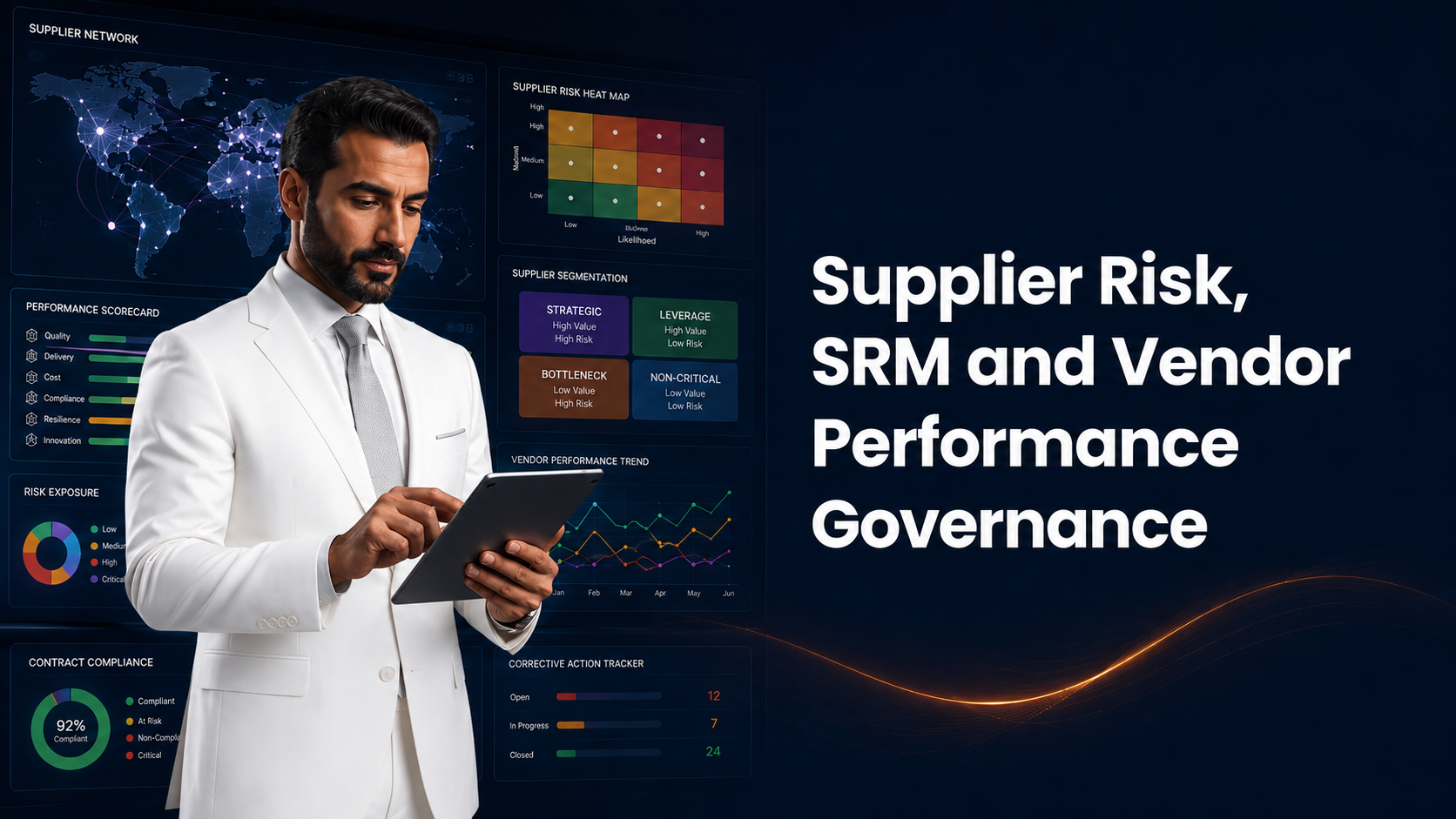
Supplier Risk, SRM and Vendor Performance Governance
A practical programme for procurement teams, PMO teams, supplier managers, and contract/commercial teams — building supplier-risk governance, SRM routines, and vendor-performance controls for major GCC projects and operations.
Course starts in
Description
Programme Highlights
Comprehensive Supplier-Risk Framework
Map risk categories, criticality, and segmentation into governance requirements proportional to actual exposure.
Rigorous Qualification & Due Diligence
Assess financial, technical, HSE, and compliance standing before a supplier ever wins critical work.
Contract-Risk Controls & Continuity Planning
Structure LDs, performance securities, and dispute triggers alongside genuine supply chain disruption resilience.
Capstone Supplier Risk Assessment & Improvement Plan
Build a complete supplier-risk assessment and performance improvement plan, ready to apply on a live vendor relationship.
Course Curriculum — 8 Modules
Supplier-Risk Framework
This module builds the conceptual foundation for treating supplier risk as a distinct governance discipline rather than an informal extension of procurement. Participants map supplier risk categories systematically — financial instability, quality failure, HSE non-compliance, capacity constraints, and geopolitical exposure common across GCC supply chains spanning multiple countries and long logistics chains. The module introduces criticality assessment: distinguishing suppliers whose failure would genuinely disrupt a project or operation from those whose failure is manageable, and building supplier segmentation that allocates governance effort proportionally. The module closes with governance requirement design: defining what level of oversight, reporting, and control each supplier tier warrants, ensuring high-risk, high-criticality suppliers receive the scrutiny they require without burying low-risk suppliers in unnecessary process.
Supplier Qualification and Due Diligence
A weak supplier admitted into the vendor base becomes tomorrow's risk incident. This module builds rigorous due diligence skills that go beyond the surface-level prequalification checks common in procurement processes. Participants assess financial stability using standard indicators appropriate for evaluating contractor and supplier solvency on long-duration GCC contracts, and build technical capability assessment that verifies a supplier can genuinely deliver at the scale and complexity required. The module covers HSE due diligence — reviewing safety performance history and management system maturity — and quality system assessment relevant to the supplier's product or service category. The module closes with compliance and capacity due diligence: verifying regulatory standing and confirming a supplier has genuine spare capacity rather than being already overcommitted elsewhere.
Performance Scorecards
Supplier performance that is not measured consistently cannot be managed consistently. This module builds practical performance scorecard design, starting with on-time delivery (OTD) measurement methodology that reflects genuine schedule impact rather than a simplistic date comparison. Participants build quality metrics tracking defect rates and non-conformance trends, and responsiveness measures that capture how quickly a supplier addresses issues once raised. The module covers safety performance metrics appropriate for GCC HSE regulatory expectations, and cost performance tracking that goes beyond price to capture total cost impact including rework and delay. The module closes with claims and contract compliance metrics: tracking a supplier's contractual discipline as a leading indicator of relationship risk, not just a lagging record of disputes.
SRM Operating Model
This module builds the operating rhythm that turns Supplier Relationship Management from a concept into a daily practice. Participants apply supplier tiering to determine the intensity of management effort each vendor relationship warrants, and build account plans for strategic and critical suppliers — structured documents that capture relationship objectives, improvement priorities, and joint value opportunities rather than treating every supplier interaction as purely transactional. The module covers structured review meeting design — cadence, agenda, and participant seniority matched to supplier tier — and joint improvement routines that turn performance data into collaborative action rather than one-sided criticism. The module closes with escalation routine design: the structured pathway that moves a persistent supplier issue from account-level management to senior governance intervention.
Contract-Risk Controls
Supplier governance is only as strong as the contractual mechanisms that back it. This module builds practical fluency in the contract-risk controls that protect against supplier underperformance on GCC contracts. Participants review key contractual terms relevant to supplier risk — warranty periods, indemnities, and termination provisions — and examine performance securities (bonds and guarantees) as financial backstops against non-performance. The module covers liquidated damages (LDs) structuring and enforcement discipline, and change control mechanisms that prevent scope creep from silently eroding supplier accountability. The module closes with dispute trigger identification: recognising the contractual and performance indicators that signal a supplier relationship is approaching formal dispute, in time to intervene before it does.
Supply Chain Continuity
A single-source supply chain is a latent crisis waiting for the right disruption. This module builds supply chain continuity planning skills, starting with disruption risk mapping — identifying where a GCC project's supply chain is vulnerable to single points of failure. Participants develop alternative source strategies, qualifying backup suppliers in advance rather than scrambling to find them mid-crisis, and build buffer strategy design: determining appropriate inventory and lead-time buffers for genuinely critical materials without over-investing in buffer stock across the entire supply chain. The module covers geopolitical and logistics risk considerations relevant to GCC import-dependent construction supply chains — shipping route disruption, regional political risk, and customs volatility — building practical resilience rather than theoretical risk registers.
Digital Supplier Reporting
Supplier governance data that lives only in scattered emails and spreadsheets cannot support consistent decision-making. This module builds practical digital supplier reporting skills, designing dashboards that bring scorecard, risk, and contract-compliance data together into a single, current view. Participants build action tracker discipline that keeps supplier improvement commitments visible and time-bound rather than verbally agreed and forgotten. The module covers evidence record management — maintaining the documented history of supplier performance, communications, and corrective actions that protects an organisation during disputes or supplier replacement decisions. The module closes with executive supplier review design: structuring periodic senior-level reviews that give leadership genuine visibility into supply chain risk exposure across a GCC project portfolio.
Capstone Supplier Review
The programme closes with an applied capstone: participants prepare a complete supplier-risk assessment and performance improvement plan for a realistic sample supplier relationship, drawing on every skill built across the previous seven modules. Working from a supplier scenario showing performance decline, contractual ambiguity, and emerging continuity risk, participants complete a risk and criticality assessment, build a performance scorecard, and design an SRM engagement plan with escalation triggers and continuity contingencies. Facilitator and peer feedback focuses on whether the finished assessment and plan would genuinely improve the supplier relationship or protect the project if it does not — not just document that a problem exists.
Frameworks, Tools & Accreditation
Course Outcome
On completing this course, you will be able to build a supplier-risk framework, conduct rigorous supplier due diligence, design performance scorecards, operate a structured SRM model, apply contract-risk controls, plan for supply chain continuity, and produce digital supplier reporting with confidence — capabilities directly applicable to procurement, PMO, supplier manager, and contract/commercial roles across major construction and infrastructure programmes in Saudi Arabia, the UAE, Qatar, and the wider GCC.
