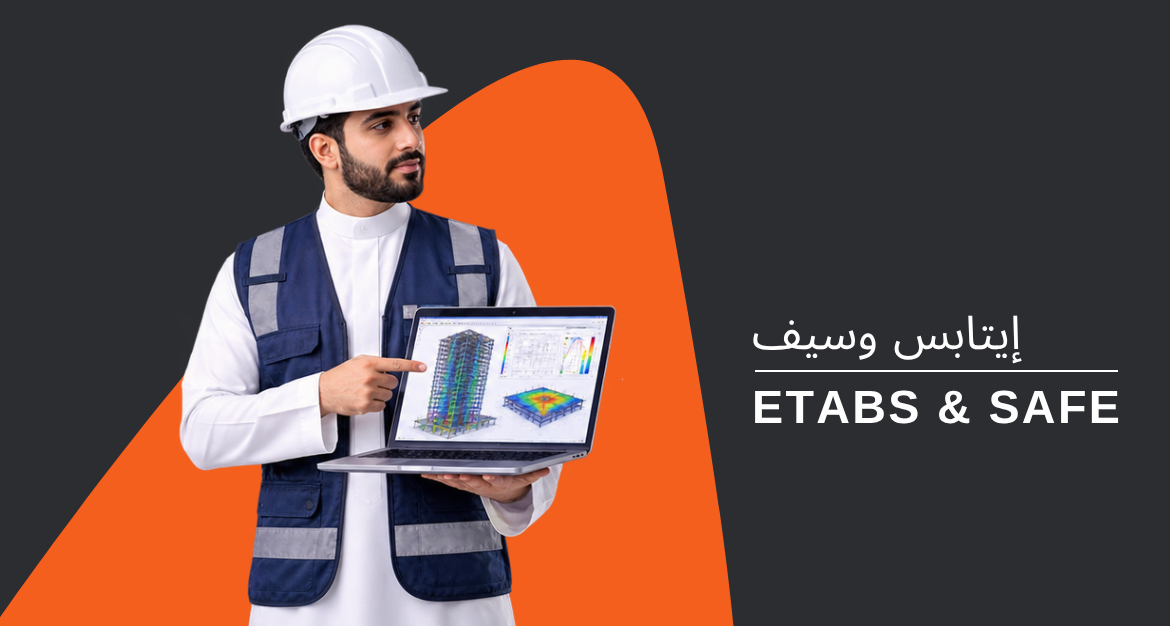
ETABS & SAFE
Live Session

ETABS & SAFE

A nine-module, project-based programme spanning the complete structural engineering workflow — from RCC building modelling and advanced seismic analysis in ETABS through fully integrated, construction-ready foundation design in SAFE — built for structural design engineers and site engineers transitioning into design roles across Saudi Arabia, the UAE, and Qatar.

  • Schedule 22 Aug 2026 Saturday · 10:37 PM
  • Instructor Rania Hussein Abdalla
  • Category Engineering

Course starts in

-- Days
-- Hours
-- Minutes
-- Seconds

Registration Form

ETABS & SAFE

SAR 1,099.00

By registering, you agree to the Terms of Service and Privacy Policy.

Description

ETABS & SAFE: Full Curriculum

Nine modules covering the complete structural-to-foundation workflow — ETABS modelling across multiple real-world residential building types, load application and RCC design, advanced seismic analysis, and full SAFE foundation design from ETABS data integration through construction-ready reinforcement drawings.

Programme Highlights

End-to-End Structural & Foundation Workflow

Move seamlessly from ETABS building modelling and analysis through fully integrated SAFE foundation design — one continuous professional pipeline, not two disconnected tools.

Multiple Real-World Buildings, One Complete Foundation System

Work through fundamentals, unsymmetrical geometry, fast AutoCAD-linked modelling, and G+3, G+4, and G+8 residential buildings — then design the foundations that support them.

Seamless ETABS-to-SAFE Data Integration

Export column and wall reactions, base shear, and overturning moment data directly from your ETABS model into SAFE, without duplicating modelling effort.

Advanced Seismic Analysis to Verified Foundation Drawings

Carry response spectrum and time-history seismic results forward into soil pressure, settlement, and punching shear checks that produce construction-ready foundation drawings.

Course Curriculum — 9 Modules

Part A — ETABS: Structural Analysis & RCC Building Design
01

Introduction to ETABS & SAFE — The Complete Structural-to-Foundation Workflow

Software Orientation, Project Setup & the GCC Structural Design Pipeline

This module introduces ETABS and SAFE as one connected professional workflow rather than two separate tools — ETABS for building structural analysis and RCC design, SAFE for the foundation design that follows directly from it. Participants set up project grids, storey data, and material properties for concrete and reinforcement grades used across Saudi and UAE construction practice, and configure the frame section and slab property libraries that will drive every model built in the programme. The module positions this combined workflow within GCC project delivery: how design offices producing residential and commercial RCC buildings for Saudi Arabia's Vision 2030 housing programmes and UAE mid-rise developments structure their analysis and design models to meet Saudi Building Code (SBC) and ACI 318 requirements from the very first grid line through the final foundation drawing.

02

RCC Building Modelling — Elements, Fast AutoCAD Workflows & Real-World Projects

Beams, Columns, Slabs & Staircases Across Multiple Residential Building Types, G+3 to G+8

This module builds the complete practical modelling skillset through hands-on work across several real building types. Participants model beams, columns, slabs, and staircases — including dog-legged, spiral, and circular stair geometry — systematically across projects ranging from a straightforward fundamentals building through an unsymmetrical layout requiring manual grid techniques and correct column orientation, up to G+3, G+4, and G+8 residential buildings common across Saudi Sakani housing schemes and UAE mid-rise developments. The module also covers the industry-standard fast-modelling workflow used by professional design offices: importing architectural DXF and DWG drawings directly into ETABS and using them as a modelling reference, dramatically reducing the time needed to turn around fast-track tender submissions under tight project timelines.

03

Load Application & Structural Analysis

Dead, Live, Wind & Seismic Loads, Load Combinations & Result Interpretation

This module builds the complete load and analysis workflow that turns a geometric model into an analysed structure. Participants apply dead, live, wind, and seismic loads and configure the service and ultimate load combinations required by ASCE 7 and Saudi Building Code SBC 301 provisions, then run the structural analysis and interpret its output — column and wall reactions, member forces, and storey deflections and drift. Particular attention is given to the practical differences that emerge at mid-rise scale: storey drift checking, column size rationalisation across floors, and the secondary beam and moment release concepts used to manage load transfer and reduce reinforcement congestion on real GCC residential projects — skills that distinguish production-ready analysis from a purely geometric exercise.

04

RCC Design & Design Verification

Reading Design Check Output, Reinforcement Design & Independent Verification Habits

This module carries the analysed model through to a complete, defensible RCC design. Participants run ETABS's design checks across beams, columns, and slabs, learn to read and interpret design check output correctly, and flag overstressed members before a design progresses further. The module places particular emphasis on independent design verification — sanity-checking reaction totals against applied loads, cross-checking critical member forces by hand for spot elements, and confirming design check flags are correctly resolved rather than accepting software output uncritically — alongside the design economy considerations that matter directly on competitively tendered GCC residential and commercial projects. These verification habits are what separate production-ready design practice from academic modelling exercise, and they carry forward as the standard applied to foundation design in Part B.

05

Advanced Seismic & Dynamic Analysis

Response Spectrum, Time-History Analysis & the Bridge to Foundation Design

The ETABS portion of the programme concludes with advanced dynamic analysis techniques that go beyond the static equivalent lateral force methods applied earlier. Participants define diaphragm and mass source concepts correctly, progress through static seismic analysis into response spectrum analysis using ETABS's built-in and site-specific spectra, and are introduced to time-history analysis for projects requiring dynamic verification beyond code-prescribed equivalent methods — increasingly required on tall or seismically sensitive structures in Saudi Arabia's higher seismic zones and NEOM's advanced infrastructure packages. Participants leave able to select and justify the appropriate seismic analysis method for a given project's height, irregularity, and regulatory context. This module closes Part A: the base shear, overturning moment, and column and wall reactions produced here become the foundation loading demand carried into Part B.

Part B — SAFE: Foundation Analysis & Design
06

Introduction to SAFE & Foundation Type Selection

Software Overview, Shallow & Deep Foundation Types & Selection Criteria

This module introduces SAFE as CSI's purpose-built platform for slab and foundation analysis and design, distinguishing its slab-and-mat-focused finite element engine from the frame-based analysis in ETABS. Participants survey the complete foundation type spectrum — isolated footings, strip footings, mat foundations, and pile foundations — and build the engineering judgement behind selecting between them, weighing soil bearing capacity and geotechnical investigation findings against structural load magnitude and site constraints such as adjacent property lines and basement or elevator pit requirements. The module frames this decision within the geotechnical realities common across the GCC coastline — sabkha soils, high water tables, and variable bearing strata found on coastal developments in Doha, Dubai, and the Eastern Province — that make foundation engineering judgement, not software defaults, the deciding factor in a safe, economical design.

07

ETABS-to-SAFE Integration & Foundation Modelling

Data Export/Import Workflow, Material & Soil Properties, and Complex Geometry Modelling

This module builds the data-exchange and modelling workflow that makes SAFE genuinely efficient rather than a re-modelling exercise. Participants export column and wall reactions, base shear, and overturning moment data directly from the Part A ETABS model into SAFE, addressing common integration pitfalls — unit mismatches, coordinate misalignment, and load case naming inconsistencies — that produce silently incorrect foundation loads if left unchecked. Participants then define concrete and reinforcement material grades, slab and column section properties, and — critically — soil subgrade modulus values that realistically represent the bearing stratum identified in the project's geotechnical report. The module concludes with geometry modelling for the layout complications that define practical design work: elevator pits and sump pits with local slab thickening, irregular site boundaries, and basement walls common on GCC podium and tower developments.

08

Foundation Load Cases, Design Strips & Code Compliance

Load Case Setup, Design Preferences (ACI, Eurocode, SBC) & Reinforcement Layout Optimization

This module builds the complete load, code, and reinforcement-layout structure that a defensible foundation design requires. Participants set up service and ultimate load combinations and soil pressure check combinations consistent with ASCE 7 and Saudi Building Code provisions, then configure design preferences based on ACI 318 as the primary GCC reference standard — comparing parameter behaviour against Eurocode 2 for projects delivered by European-standard consultancies operating in the region. The module concludes with design strips, SAFE's mechanism for translating finite element results into practical, constructible reinforcement layouts: participants define column and middle strips across mat and slab foundations and learn to balance analytical accuracy against constructability, reducing steel tonnage without compromising code compliance — a cost-sensitivity that matters directly on competitively tendered GCC foundation packages.

09

Stability Checks & Construction-Ready Foundation Design

Soil Pressure, Settlement & Punching Shear Verification and Final Reinforcement Drawings

The programme concludes with the verification checks and final deliverables that determine whether a foundation design is genuinely safe and buildable. Participants run soil pressure checks to confirm bearing capacity is respected under every governing load combination, interpret settlement output to identify differential settlement risk, and perform punching shear checks at column-slab connections — the failure mode most frequently responsible for foundation distress on GCC projects with heavily loaded columns on thin mat sections. Participants then generate flexural and shear reinforcement designs directly from design strip results and produce detailed construction drawings formatted for direct export to AutoCAD, matching the drawing conventions expected on GCC authority submission and contractor issue-for-construction packages. Participants leave able to carry a project from ETABS structural modelling through fully verified, code-compliant, construction-ready foundation drawings.

Software, Standards & Platforms

ETABSSAFEETABS-to-SAFE IntegrationAutoCADDXF/DWG ImportRCC DesignMat FoundationsDesign StripsPunching Shear CheckPile FoundationsSoil Subgrade ModulusACI 318ASCE 7Eurocode 2Saudi Building Code (SBC)Response Spectrum AnalysisTime-History Analysis

Course Outcome

On completing this course

On completing this course, you will be able to independently model, analyse, and design complete RCC building structures in ETABS — including seismic and dynamic analysis — and carry that structural model directly into SAFE to produce fully verified, construction-ready foundation designs. These combined skills are directly applicable to structural design engineer, foundation design specialist, and structural-to-foundation coordination roles across Saudi Arabia, the UAE, and Qatar.

9 Modules · ETABS Structural Design to SAFE Foundation Engineering · G+3 to G+8 · Advanced Seismic & Geotechnical Analysis

From Blank Grid to Fully Designed Structure and Foundation

Build the complete ETABS-to-SAFE structural and foundation design skill set demanded on residential and commercial RCC building projects across Saudi Arabia, the UAE, Qatar, and the wider GCC construction sector.

Requirements

No prior ETABS experience is required. This course is designed for beginners.
Willingness to practice by working on real-world building projects.
ETABS software installed on your computer.
Basic knowledge of structural engineering concepts is helpful but not mandatory.
AutoCAD knowledge is beneficial but not required.

Who this Course is for

Civil Engineering Students
Diploma & B.E. Civil Engineering Students
Engineers seeking practical ETABS expertise
Fresh Graduates preparing for structural design careers
Site Engineers transitioning into design roles